Articles by winners from the Fetisov Journalism Awards 2026: Wolfgang Bauer “The Forgotten”
On 22 April, the Fetisov Journalism Awards, supported by the Ethical Journalism Network were held in Cyprus. Wolfgang Bauer, who wrote a powerful series for Die Zeit in Germany on the “forgotten” war in Sudan won first prize in the category for contribution to peace and scooped more than 100,000 Euro. In his acceptance speech he called for journalists and news media the world over not to ignore the horrors of war. Here is what he said:
Journalists must speak out when the world ignores the cruel inhumanity of war Wolfgang Bauer who won the Outstanding Contribution to Peace prize at this year’s Fetisov Journalism Awards for his report, The Forgotten, issued a call to journalists and news media not to turn away from the stories the world most needs to hear about. When news media ignore the suffering of the most vulnerable people, he warned, we all pay a heavy price.
In a moving speech at the ceremony in Limassol, Cyprus on 22 April, he reflected on two weeks spent inside Al-Naw hospital in Omdurman, the last functioning surgical facility in Sudan’s besieged capital, where he and photographer Johanna Maria Fritz were among the only foreign journalists
in the country.
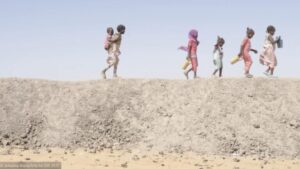
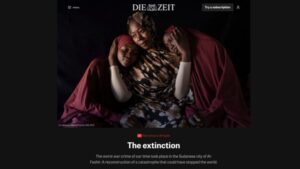
I thank the jury for having the courage not to look away from the horrors that have occurred and continue to occur in Sudan. That’s just how it is in our media business: we’re spending attention less and less. We’d rather stay in our offices and do our research over the phone. Less and less often, we go out to the people, out to the villages where the future is decided.
We are increasingly trapped in the algorithm of editorial systems.
Which topics got the most clicks, which topics led to subscriptions?
The world of events and international connections has become so vast, but the world of commercial journalism has become so small – and is growing ever smaller.
We tend to report on mental health, partnerships, income, how to make money, and Trump-Boy. We report less and less on the unexpected, the
new, and the complex. And that is why we almost never report on the bloodiest conflict of our time: the war in Sudan. I have reported on so many conflicts around the world, but rarely have I been so lost for words as during these two weeks in the hospital of Al-Naw in Omdurman, part of Sudan’s capital. At that time, more than a year ago, Al-Naw was the only hospital in Sudan’s capital that still had the capacity to perform major operations. It was the last resort for tens of thousands of people. Their last hope.
A hope that would prove futile for so many. The dying in this hospital, surrounded on three sides by the front line and exposed to rocket fire
almost daily, was overwhelming. I believed, I know death. It is a constant companion in my work – but this death was new to me. So much death in such a small space. And so few people here in Europe who care about this suffering. During our research, we – the photographer Johanna Maria Fritz and I – were the only foreign journalists in this large, wounded, bleeding country. No one knows the exact number of victims of this war; no one counts the dead, the injured, the raped. No one is paying attention anymore.
Or have we ever paid attention? For the leaders of the fighting factions, war has long been a better business than peace. The major powers, America
and Europa, have turned away and left Sudan to the claws and power appetite of unleashed regional powers. If it is true that the future is being written in Africa, then it will be a very bleak future. Because it is not only Sudan that is bleeding, but also Mali, Niger and Burkina Faso. The state architecture of an entire region is disintegrating.
If we do not care about the suffering of others, the pain of Muna Majek, the pain of Hassan al-Tahan, of Seinab Issa, of Nada Abdulgassim, then we
should at least care about our own pain. We don’t feel it yet. This nightmare still seems far away. But our neighbours’ nightmare could soon be ours.
That is why I ask everyone, not to turn away!
There is so much suffering in this world. It is hard to bear. Many look away. I understand that. But I cannot. I am afraid to look away. I am afraid of
losing parts of my humanity. I am afraid to loose the reason, I breathe, the reason I eat, the reason I think. I have so many people to thank. First and foremost, our friend and translator Ismail Al Sheiki, the photographer Johanna Maria Fritz and her patience, my editorial team, who have the commercial madness to send reporters to countries like Sudan. And I thank all the doctors, nurses and volunteers at Al-Naw Hospital for what they do every single day, also tonight, which will be another night when people die in Al Naw.
Images: WANIFRA & Die Zeit’s special report: ‘War crimes in Al-Fashir’